Words with a silent K, plus Bren’s breadmaking video blog
Brendan shows you how to make flatbread in his latest video blog! Plus, learn how to pronounce English words with a silent K
Hello, I’m Jane at DailyStep English and welcome to our Audio Blog.
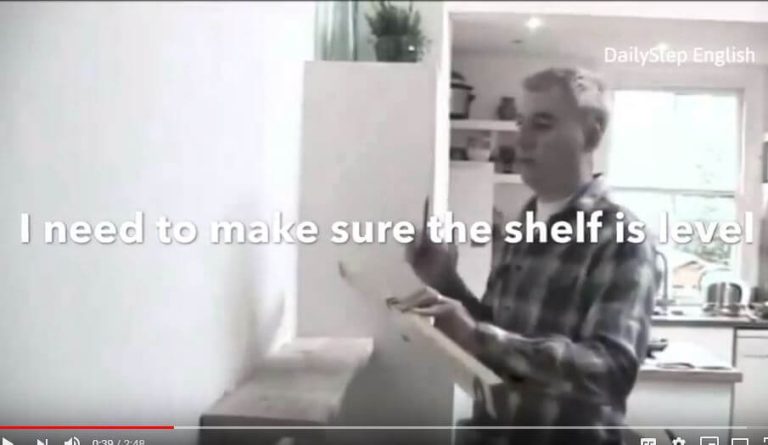
This week, Brendan is going to show you how to make some flatbread – it’s really easy to make and delicious to eat!
Then in the Audio Word Study, you can learn some words in English that are spelled with a silent K. In other words, the spelling and pronunciation are very different!
So, over to Bren now – he’s going to give us another cookery demonstration!
Making Flatbread
(by Brendan O’Connell at DailyStep.com)
Brendan: Hi, today I’m going to show you how to bake[1] flatbreads[2] .
Ok, I’ll show you the ingredients we need. First of all, we need some flour, some yeast, some oil – I use olive oil -and a little bit of salt.
And we also need some kitchen utensils or tools, for example we need the rolling pin for rolling, we need a bowl to mix the ingredients in, we need a jug so we can get the correct amount of liquid and also we need some scales so we can weigh the flour.
First of all we have to mix the flour, the yeast and the salt together.
I use a mixture of flour. I use wholemealflour[3] and plain flour, five hundred (500) grams.
So, first of all I’m going to weigh out[4] two hundred and fifty (250) grams of wholemeal flour, 250 grams of plain flour then one teaspoon[5] of yeast[6] .
You add the yeast to make the bread rise – it has a chemical reaction with everything else – and one and a half teaspoons of salt
Jane: That seems like a lot.
Brendan: Well, it makes a lot of bread. Ok, then I mix all this together and then I add three hundred and twenty-five 325 milligrams of warm water. It has to be warm.
Jane: Why does it have to be warm?
Brendan: I think it helps the chemical reaction to take place[7] . And a little bit of olive oil.
Ok, now I am going to mix all that together with my hands. Now I’ve mixed all the ingredients together and this is called dough, a mixture of flour and water is called dough.
It’s what we make the bread with. Now, first of all sprinkle a little bit of flour onto the work surface.
Jane: Why do you do that?
Brendan: So that the dough doesn’t stick to the work surface, it’s very sticky.
So, now the thing I have to do is I have to knead thebread[8], which is squash it, press it together like this, pushing your thumbs into the bread. Hard work you know!
Jane: Yes, but not that hard! (Ten minutes later)
Brendan: Ok, so that’s the dough, I’ve rolled it into a ball. It’s ready.
So, the only thing I’ve got to do is put a little bit of olive oil in the bowl and roll the dough in that so that it is coated in oliveoil[9] .
Then cover that with a cloth and leave it in a warm place for about an hour until the dough has risen.
Now, as you can see the ball of dough has got bigger it has risen, it’s about two times bigger than it was before.
Now, this will make about 8 flatbreads. So, just make it flexible[10] again. So, break it into pieces say about the size of a golf ball so make a ball about that big.
Jane: That’s a big golf ball.
Brendan: Do you play a lot of golf?
Jane: It looks a bit more like a tennis ball to me but never mind[11].
Brendan: OK. So then, put that on the worktop and try and make a round piece of bread. With the rolling pin I want to squash the bread to make it bigger so it’s nice and thin.
Now, because these are flatbreads we don’t cook them in the oven. I’m gonna [12]cook them in a pan but with no oil. In this frying pan. So you have to get the pan very hot.
Ok, that’s cooked now, it’s brown on both sides. So, I put it on the plate.
Jane: Lovely! Nice and golden brown. Bit of a funny shape[13] .
Notes:
1. to bake = to cook bread, cakes or pies (we normally bake things in the oven)
2. flatbreads = flat pieces of bread (bread that is allowed to rise is called a loaf of bread)
3. wholemeal flour = flour which contains all the grain, it is unrefined so therefore it is more healthy than plain flour
4. to weigh out (phrasal verb) = to weigh / to measure the weight of
5. a teaspoon = a small spoon which we normally use to put sugar in tea or coffee
6. yeast = a fungus which is used to make bread rise and is also used to ferment beer
7. to take place = to happen / to occur
8. to knead the bread = to manipulate the dough in order to make it elastic and capture the gases formed by the yeast
9. it is coated in olive oil = it is covered by a thin layer of olive oil
10. flexible = elastic / easy to manipulate
11. never mind = that’s OK / it doesn’t matter
12. I’m gonna cook (informal, spoken English only) = I am going to cook
13. Bit of a funny shape = It has an unusual form / it has a strange shape
Here is Audio Word Study #073 on DailyStep.com
.
In Bren’s DailyStep video on making flatbread, you can see him kneading the dough before he cooks the bread.
Like some other words in English, KNEAD has a silent K. , The K in these words used to be pronounced as well, but this changed sometime around the sixteenth (16th) Century.
So the silent K is a remnant of Old English.
.
Listen to how these words are pronounced!
.
1. KNEAD Bren says that kneading the dough is hard work – it looks quite easy to me!
.
2. KNEE Your knees are the joints around halfway down your legs. Without knees, we
would not be able to climb stairs!
.
3. KNEEL If you rest on your knees, we say that you are kneeling, or sometimes, we say you are kneeling down.
.
4. KNOW, KNEW, KNOWN This verb is irregular. It is important to know how to use it!
.
5. KNOWLEDGE One of my favourite proverbs is ‘KNOWLEDGE IS POWER’
.
6. KNIFE We use a knife for cutting things. We need to sharpen knives to keep them sharp.
.
7. KNOCK I heard a knock at the door so I went to the door and opened it.
.
8. KNOB The door knob came off in my hand when I was opening the door.
.
9. KNOT A knot is made by tying together the ends of a piece of string or rope.
.
10. KNIT Knitting is the action of making clothes by using two long needles to connect wool or another type of thread into joined rows. Sweaters are often knitted from balls of wool.
.
11. KNACK A knack is a skill or an ability to do something easily and well. For example, my brother has a knack for fixing things – he can fix nearly anything!
.
12. KNUCKLE Your knuckles are the joints between your fingers and the main part of your hands.
.
13. KNICK-KNACK This is a small object, usually in the house, that is often decorative or has sentimental value. I have a shelf in the living room that is covered in knick-knacks – Brendan would prefer me to throw some of them away, but I’m not going to!
.
.
Now, how many of these can you remember? Read and listen to this Audio Word Study again, and try speaking along with the audio file. Then write your own sentences using these words. That’s all for Audio Word Study#073 on DailyStep.com.
If you enjoyed my Audio Blog, please share it. Thank you 🙂
How to speak English fluently and understand fast English
DailyStep English Audio Lessons are designed to help you learn to speak and understand English at the speed that we speak it.
No matter how good your English is, you need to be able to follow a fast conversation in order to participate.
DailyStep English courses are fully accredited and you can get an internationally-recognised certificate for your CV or resume.
How to use your lessons:
How to slow the audio:
How to Start Daily Audio Lessons
✔ Daily Audio Lessons + Premium Audio in my Blog Library
✔ Your lessons never expire – you can take them again any time
✔ Change your level any time
✔ 100% happy or your money back!