MUST and CAN’T for logical conclusions
To download this premium audio, please subscribe to DailyStep English Audio Lessons. This will give you 5 Audio Lessons per week, plus full access to hear and download all DailyStep blogs.

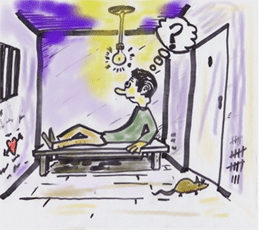
Harry must be crazy!
(By Brendan O’Connell and Jane Lawson at DailyStep.com)
.
Harry opened his eyes slowly and looked around the room. “I must be dreaming,” he thought, “this looks just like a police cell!” He closed his eyes again, then realised with a shock that he was lying on a hard bed in a small room with bars on the window and a large metal door.
.
“Oh no, I can’t be dreaming – this is really happening! This really is a police cell. But how did I get here?” Poor Harry could not remember anything at all! His mouth was dry and he had a pounding headache. “I must have drunk too much last night but… no, I can’t have drunk too much because I never drink more than one glass of wine.”
Then Harry started to remember a little about the night before. He had gone to a nice Italian restaurant with Mavis. It was their second date and things were going well but something must have gone wrong during the meal. What had he done?
Harry sat up on the hard bed and put his hand in his pocket. To his surprise, he found a small packet of pills. He read the label, which said “Warning! Do not mix with alcohol!” Then Harry remembered that his doctor had prescribed some powerful painkillers for Harry’s bad back, but the doctor can’t have mentioned that it was dangerous to mix them with alcohol and Harry must have forgotten to read the instructions on the packet.
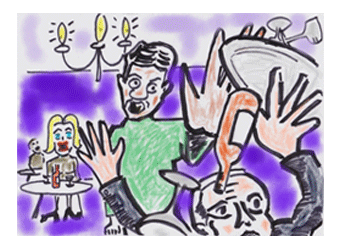
Suddenly, and with great embarrassment, Harry remembered more of what had happened the previous night. He saw himself dancing wildly in the middle of the busy restaurant to his favourite Abba song, Dancing Queen. The waiter had asked him to sit down but Harry had pushed him over, causing him to drop several plates of food. He had then tried to persuade Mavis to dance with him but she had started to cry and had run out of the restaurant. She must have thought that he had gone completely mad. The last thing he could remember was seeing two big, angry-looking policemen entering the restaurant. He had tried to escape through the kitchen but they must have caught him. The police must have arrested him and locked him in this cell.
“Oh no what have I done,” he thought, “the pills must have reacted with the alcohol and caused me to behave like a drunken hooligan. Mavis must have been so embarrassed. Will she ever forgive me? Why do I always get it so wrong?”
In this story about poor Harry, I have highlighted all the uses of the modal verbs MUST and CAN’T. These two modal verbs have many uses in English, but in this story they are all used for reaching logical conclusions. Take a look at the Audio Word Study below to learn how to use these structures.
Here is Audio Word Study #084 on DailyStep.com
. ..
In today’s Word Study, I’ll explain how to use the modal verbs MUST and CAN’T when you are expressing logical conclusions in English. Let’s take a closer look at some of the structures in the story above, Harry must be crazy!
.
Here are Harry’s first two thoughts when he wakes up in the police cell, and then in purple font, another way of expressing each of those thoughts.
.
1. I must be dreaming. = The logical conclusion is that I am dreaming.
2. I can’t be dreaming. = The logical conclusion is that I am not dreaming.
.
In sentence 1, Harry uses MUST + BARE INFINITIVE to express a positive logical conclusion. In other words, he concludes that something is happening now so he uses MUST + BARE PRESENT CONTINUOUS INFINITIVE , in other words, MUST + BE DREAMING. “I must be dreaming!”
.
In sentence 2, Harry uses CAN’T + BARE INFINITIVE to express a negative logical conclusion. He concludes that something is not happening now, so he uses CAN’T + BARE PRESENT CONTINUOUS INFINITIVE , in other words, CAN’T + BE DREAMING. “I can’t be dreaming!”
.
By the way, a BARE INFINITIVE is an INFINITIVE without TO. I will teach you more about how to use infinitives and modals in a blog coming soon, but for now, let’s focus only on how to use MUST and CAN’T.
.
Here are Harry’s second two thoughts when he wakes up in the police cell, and then in purple font, another way of expressing each of those thoughts.
.
3. I must have drunk too much last night. = The logical conclusion is that I drank too much last night.
4. I can’t have drunk too much last night. = The logical conclusion is that I did not drink too much last night.
.
In sentence 3, Harry uses MUST + BARE INFINITIVE to express a positive logical conclusion. He concludes that something happened in the past, so he uses MUST + BARE PERFECT INFINITIVE, in other words, MUST + HAVE DRUNK. “I must have drunk too much last night!”
.
In sentence 4, Harry uses CAN’T + BARE INFINITIVE to express a negative logical conclusion about the past. He concludes that something did not happen in the past, so he uses CAN’T + BARE PERFECT INFINITIVE , in other words, CAN’T + HAVE DRUNK. “I can’t have drunk too much.”
.
Now, listen to more examples of Harry’s logical conclusions, and this time listen carefully to the pronunciation of the word HAVE in the bare perfect infinitive.
.
5 . . It was their second date and things were going well but something must have gone wrong during the meal.
.
6 . The doctor can’t have mentioned that it was dangerous to mix the painkillers with alcohol and Harry must have forgotten to read the instructions on the packet.
.
7. Mavis must have been so embarrassed. Will she ever forgive me?
.
What did you notice about the pronunciation of HAVE? Or did you even hear the word at all? English speaking children often think, until they are corrected at school, that the word is OF, so they say, for example, HE MUST OF DONE IT, or HE CAN’T OF DONE IT. But in fact the pronunciation is even weaker than OF. We say it like this:
.
mʌst əv dʌn ɪt = must have done it.
ka:nt əv dʌn ɪt = can’t have done it.
.
For this reason, it is often easy to miss these structures when you are listening to native English speakers. Subscribers to our DailyStep Audio lessons sometimes ask me if the word has been omitted completely, because they can’t hear it in the sentence. But this is the way we actually speak, so keep practising with your DailyStep lessons and you will find that you don’t make these mistakes again!
.
Now, read and listen to this Audio Word Study again, and try speaking along with the audio file. That’s all for Audio Word Study #084 on DailyStep.com.
What is a DailyStep English Audio Lesson?
More English Courses
I also produce IELTS and other exam courses, and other courses where you can learn English through literature, drama, comedy, history, natural conversation and more!
more | plus | más | altro | 続き | 자세히
How does a DailyStep subscription work?
.
DailyStep Audio lessons make you speak English like a native speaker for a short time each day, and help you to understand native speakers perfectly.
.
If you subscribe to my regular DailyStep audio lessons, I will send you 5 expertly- designed audio lessons per week, so every month you get approximately 22 lessons per level. You choose the level yourself that you think will be challenging for you – not too easy, not too hard – and you can change your level, or add more levels, at any time after joining.
- Each weekday (Monday to Friday), you receive an email containing a link that takes you straight to your audio lesson.
- Each audio lesson contains a short conversation, with an audio file and script, as well as vocabulary and style notes to help you understand it.
- Key phrases in the conversation are hidden at first so you can test your listening skills. You can then uncover the hidden text.
- There are 2 audio files per lesson – one at fast, natural speed and a second audio file that is slowed down using special software to 65% of natural speed. This allows you to hear exactly how the language works.
- You copy the native speakers by speaking along with the audio files to improve your pronunciation, rhythm, speed and intonation.
- All your lessons are stored for you in an online Personal Lesson Bank so you can log in to take them again any time, or take lessons you have missed – even after your subscription has expired!
- You can download the MP3 audio files to your computer, mobile phone or i-pod.
- The lessons take only 5 – 10 minutes each day to complete, and you can log in and take your lessons from any computer.
- There are no advertisements to distract your attention.
.
As a subscriber, you will also get full access and download rights to the audio in my Teacher’s Blogs, with cultural articles and downloadable audio grammar lessons.
.
DailyStep Audio Lessons are exceptionally good value – I believe in keeping prices down so that better English is affordable for everyone! There is a 30-day money back guarantee, so there is no risk at all! So what are you waiting for? A journey of a thousand miles begins with a single step!