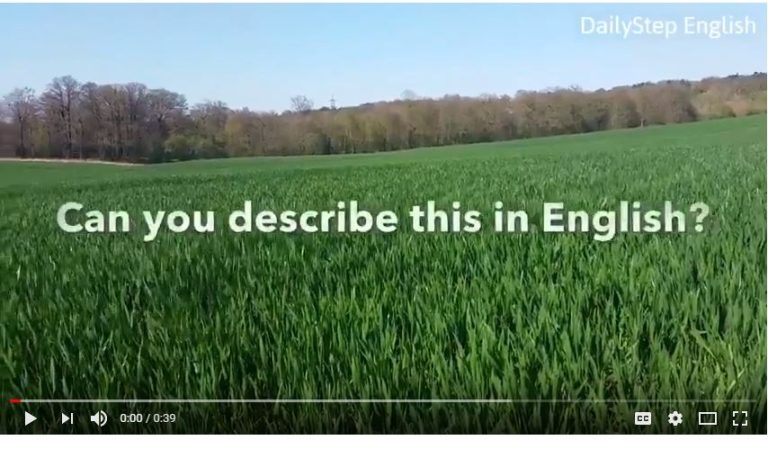
Learn countryside vocabulary in Brendan’s latest video blog
Brendan takes a walk in the English countryside. Plus, learn about differences between northern and southern English accents
Hello, I’m Jane at DailyStep English and welcome to our Audio Blog!
.
This week Brendan is going to take you for a walk in the English countryside. It will be a chance for you to see Britain in the winter and also a little lesson on the importance of listening to your wife.
If you are new to DailyStep English – welcome 🙂 Please sign up here for more free Audio Lessons.
.
OK, so let’s take a walk with Brendan!
A walk in the English countryside
(by Brendan O’Connell at DailyStep.com)
Jane: Oh, where are you going?
Bren: I’m going for a walk in the countryside[1] . I’ve got a map and I’ve got a compass[2], just in case[3] I get lost[4] .
Jane: Right, OK well just make sure you stay on the path[5], I mean there are some pretty dangerous farm animals out there, you know.
Bren: They’re not wild animals they’re just farm animals and it’s not the jungle[6] . Don’t worry[7]! I’ll be OK. I’ll see you later.
Jane: See you later.
Bren: Bye! (Brendan walks out of the room and we then see a shot of a wooden sign with the word footpath written on it.)
Bren: So, here is a wooden sign pointing[8] in three different directions.
I’m going to follow the one on the left and that should take me into town[9] . I’m walking down a narrow country lane[10] which has hedges[11] and bushes[12] on both sides.
Now, I could take the road into town but I think it would be much more interesting to cross the fields.
So, I’m going to take a short cut[13] across the fields following this footpath. As you can see it is winter and the trees are bare[14] because the leaves[15] all fell off[16] in the autumn but spring will be here soon so all the leaves will grow again, the flowers will blossom[17] and the whole landscape will turn a beautiful green[18].
But I think that even in winter this landscape has a strange kind of mysterious[19] beauty. Anyway, let’s walk on[20] now.
Now I am walking through the woods[21] and just in front of me a little bit further down the path you can see an old wooden bridge that crosses the river and if you listen carefully you can hear the sound of the water flowing[22] over the rocks.
I think that’s a very peaceful and relaxing sound. Now, here are some steps. I’m going to climb[23] the steps to the top of the hill.
Look at this beautiful farm house. If I were a farmer I’d like to live[24] in this farm house and be surrounded by all this beautiful countryside[25].
Oh, look the ground here is very soft and muddy[26] and if you look carefully you can see the footprints[27] of both animals and people that have passed this way.
I wonder[28] what type of animals they were? If you listen you can hear the birds tweeting[29]. Listen to the birds. I love that sound! Birds tweeting. There are two horses in this field eating grass.
Now, I know that Jane said that I shouldn’t leave the path but I’m just going to see what’s in this field over here. (We see a flock of sheep[30] in a field)
There’s nothing quite as peaceful as a day in the English countryside. (Suddenly, we hear the sound of bull.)
Bren: Oh my God! What was that? That looks like a very angry bull. I think it’s time to run for my life[31]. (We hear the sound of Brendan running away[32], panting[33] and the bull charging[34] and grunting)
I should have listened to Jane[35] and stayed on the path!
Yes, Brendan, you should have listened to me and stayed on the path!
Did you notice Brendan’s Northern English accent? He’s from a town near Manchester in Northern England, and I’m from Hampshire in Southern England.
So, Brendan says ‘countryside’ /ˈkʊntrɪsæd/ and I say ‘countryside’ /ˈkʌntrɪsɑɪd/ .
Brendan says ‘path’ /pæθ/ and I say ‘path’ /pɑːθ/
Brendan says ‘grass’ /græs/ and I say ‘grass’ /grɑːs/.
Brendan says ‘muddy’ /ˈmʊdɪː/ and I say ‘muddy’ /ˈmʌdɪː/.
t’s quite a similar accent in some ways but it’s just the vowel sounds that are different.
You can find explanations of all the notes from Brendan’s Blog in the Audio Word Study below, and if you are a subscriber to our Daily Audio Lessons, you can also hear and download the Audio Word Study.
Here is Audio Word Study 064 on DailyStep.com
Here are all the useful expressions from Bren’s Blog, taking a walk in the countryside. To help you remember the phrases in this Word Study, try to speak along with my audio recording.
1. the countryside = areas of natural land or farmland in between urban areas
2. a compass = an instrument with a needle which points to magnetic north (Brendan has got one on his i-phone)
3. just in case I get lost = in the event that I can’t find my way (just in case = as a precaution)
4. I get lost = I can’t find my destination / I become lost
5. make sure you stay on the path = be careful not to leave the path / make sure you do not leave the footpath
6. the jungle = areas of forest which contain many wild plants and animals (usually in Africa, Asia and South America)
7. Don’t worry (function: giving reassurance) = Do not concern yourself
8. pointing = indicating (in the way that someone does with their finger when drawing attention to something)
9. that should take me into town (function: expressing expectation) = that I expect will go in the direction of the town
10. narrow country lane = small, thin road or track in the countryside
11. hedges = rows of small trees that surround a field or gardenand which are grown to provide a physical barrier or fence
12. bushes = small plants with many small branches giving the plant a rounded shape
13. to take a short cut (idiom) = to take the quickest and most direct route
14. bare = naked / without covering
15. the leaves = the small, flat, usually green parts of a tree that are found at the end of twigs and branches
16. fell off (phrasal verb: to fall off) = became detached and fell to the ground
17. the flowers will blossom = the flowers will appear again (with all their colour)
18. the whole landscape will turn a beautiful green = the whole scene will become a very attractive green colour
19. mysterious = enigmatic / strange / full of mystery
20. walk on (phrasal verb) = continue walking
21. the woods = an area of land covered with a thick growth of trees (a smaller group of trees is called a wood; a larger one is a forest.)
22. flowing = moving (note: we use ‘flowing’ when we are talking about liquids, electricity or traffic)
23. to climb = to ascend / to go up (phrasal verb)
24. If I were a farmer, I’d like to live… (hypothetical sentence) = I am not a farmer but if I imagine myself as a farmer, I think I would like to live…
25. be surrounded by this farmland = have this farmland all around
26. muddy = covered by soft, wet, sticky earth
27. the footprints = the impressions of feet or shoes
28. I wonder = I am curious to know / I ask myself
29. the birds tweeting = the birds singing (note: we can also use the word ‘twitter’ and that is where the word for the social networking site Twitter comes from!)
30. a flock of sheep = a group of sheep (note: ‘a flock’ is the collective noun for many groups of animals, such as a flock of birds. Others are grouped in herds e.g. a herd of elephants, and groups of insects are called swarms e.g. a swarm of bees)
31. to run for my life (idiom) = to escape and try to save my life
32. running away (phrasal verb) = escaping / fleeing
33. panting = breathing very heavily after physical exertion
34. the bull charging = the bull running towards its target
35. grunting = making deep, aggressive animal noises
Now, how many of these can you remember? Watch the video again, read the script and try to find all these words and phrases. That’s all for Audio Word Study #064 on DailyStep.com.
If you enjoyed my Audio Blog, please share it. Thank you 🙂
How to speak English fluently and understand fast English
DailyStep English Audio Lessons are designed to help you learn to speak and understand English at the speed that we speak it.
No matter how good your English is, you need to be able to follow a fast conversation in order to participate.
DailyStep English courses are fully accredited and you can get an internationally-recognised certificate for your CV or resume.
How to use your lessons:
How to slow the audio:
How to Start Daily Audio Lessons
✔ Daily Audio Lessons + Premium Audio in my Blog Library
✔ Your lessons never expire – you can take them again any time
✔ Change your level any time
✔ 100% happy or your money back!