Scientific English: how is a rainbow formed?
Hello, I’m Jane at DailyStep English and welcome to my Audio blog.
.
In this blog I want to show you a photograph that I took in London recently of a rainbow, and tell you a little bit about how rainbows are formed. Then, in the Audio Word Study, we will look at some of the scientific words from the article, and some other meanings that they have.
OK, so let’s move on and look at how a rainbow is formed!
.
.
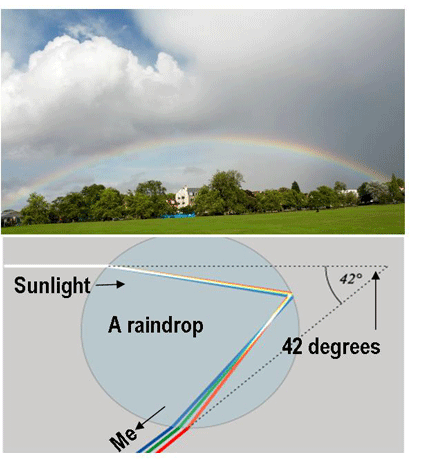
Rainbows
(by Jane Lawson at DailyStep.com).
Isn’t it wonderful when a rainbow suddenly appears in front of you? There is something truly magical about it!
The rainbow in this picture appeared while we were driving in the late afternoon. As soon as I saw this rainbow, I jumped out of the car and took this picture.
We all know that rainbows occur when it is raining and sunny at the same time. These weather conditions can cause white light to split into its full spectrum of coloured light.
There are 7 colours in the spectrum: red, orange, yellow, green, blue, indigo and violet.
But how exactly does a rainbow form? Interestingly, the location of the rainbow totally depends on the position of the person who can see it, and on the position of the sun relative to that person.
If the sun is shining towards your eyes, you will never see a rainbow. The sun needs to be behind you – so you will never be able to see a rainbow and the sun at the same time.
What happens is this: Light from the sun enters the raindrops, and because the density of the rain water is different from the density of the air, the sunlight refracts, that is, it bends slightly.
When the light bends, it splits into a spectrum of coloured light because different colours of light refract at slightly different angles.
Some of this coloured light is reflected back off the internal surface of the raindrop, similar to a mirror.
When we see this reflected light, the reason that we see each colour separately is that each colour of light bends back out of the raindrop at a slightly different angle, so we see all red light at an angle of 42 degrees between us and the sun, and all violet light at an angle of 40 degrees between us and the sun and the other colours at angles between 40 and 42 degrees.
You can see a diagram of how this works in the bottom picture!.
So that’s the science! But there are legends and myths surrounding rainbows as well. My favourite is that there is a pot of gold at the end of the rainbow.
It is impossible to find the end of a rainbow, though, so this gold will always be out of our reach!
Anyway, that’s enough about rainbows for now! Let’s move on to our Audio Word Study where I’ll teach you more about some of the scientific words in this article, and some of their other meanings.
Here is Audio Word Study #056 from Jane Lawson at DailyStep.com
.. . .
Some of the scientific words from the article above about how rainbows are formed also have other meanings too. Let’s take a look at some of these words now:
.
SPECTRUM (noun)
Meaning: the set of colours into which a beam of light can be separated, or a range of waves, such as light waves or radio waves. We also talk about ‘the political spectrum’ when we mean ‘the range of political viewpoints’
Examples: 1. Rainbows occur when raindrops split sunlight into the seven colours of the spectrum – red, orange, yellow, green, blue, indigo and violet.
2. This policy has been popular across the political spectrum. (note: this means ‘ across the range of political opinions’.)
.
DENSITY (noun)
Meaning: the number of particles, people or things in a space when compared with the size of the space
Examples: 1. Water has a higher density than air, which means there are more particles in water than in the same volume of air.
2. South East England has a higher population density than South West England, which means there are more people per square kilometre living in South East England than in South West England.
.
REFLECT (verb)
Meaning 1: If a surface reflects light, heat, sound, or an image, it sends the light, etc. back and does not absorb it.
Example: In my photo, you could see light of the camera flash reflected in the mirror.
Meaning 2: Show or reveal
Example: The results of the opinion poll reflect a change in people’s attitudes. (note: this means that we can see from the results of the opinion poll that people’s attitudes have changed.)
.
ANGLE (noun)
Meaning 1: the space between two lines or surfaces at the point at which they touch each other. Angles are measures in degrees, for example “an angle of 42 degrees.”
Example: The room is a strange shape – instead of having 4 walls and the usual right angle corners of 90 degrees, it only has 3 walls and is shaped like a triangle.
Meaning 2: a way of considering, judging or approaching something, especially a problem or controversial view
Example: I think you are approaching the problem from the wrong angle – try looking at it another way!
.
DEGREE (noun)
Meaning 1: any of various units of measurement, especially of temperature or angles, usually shown by the symbol ° written after a number.
Examples: 1. Water boils at 100° centigrade (one hundred degrees centigrade)
2. An angle of 90° is called a right angle.
Meaning 2: (an) amount or level of something
Examples: 1. This task requires a high degree of skill. (note: here, we could also say ‘ a high level of skill.)
2. I agree with you to a certain degree. (note: here, we could also say ‘ to a certain extent’.)
Meaning 3: a qualification from university
Example: He has a degree in mathematics.
.
That’s all for Audio Word Study #056 on DailyStep.com.
If you enjoyed my Audio Blog, please share it. Thank you :)
How to speak English fluently and understand fast English
DailyStep English Audio Lessons are designed to help you learn to speak and understand English at the speed that we speak it.
No matter how good your English is, you need to be able to follow a fast conversation in order to participate.
DailyStep English courses are fully accredited and you can get an internationally-recognised certificate for your CV or resume.
How to use your lessons:
How to slow the audio:
How to Start Daily Audio Lessons
✔ Daily Audio Lessons + Premium Audio in my Blog Library
✔ Your lessons never expire – you can take them again any time
✔ Change your level any time
✔ 100% happy or your money back!